


It has been quite a while since I walked with a camera slung over my shoulder.
Since I lost interest in golf, I haven't had much reason to walk. Just as I was starting to feel a bit restless, the recent hike in gas prices gave me an excuse to save fuel and do something for my health. It feels good.
When you walk, you begin to see things that are invisible when you’re passing by in a car. Especially when carrying a heavy camera, you start to look at the world through its lens, wondering, "What would the camera like to see?" Your gaze becomes anything but ordinary.
This act is called Street Photography—capturing the "eye candy" of the streets. I try to shoot like Henri Cartier-Bresson, but that "decisive moment" is elusive. After all, how can two sets of eyes ever see exactly the same way?
Lao people love having their photos taken. Children are no exception. The moment they notice a camera, their hands go up in a peace sign and they break into a smile. Is there anyone who dislikes a smiling face?
However, I keep pressing the shutter until I get the specific expression I want from a face. If it doesn't come naturally, I use hand gestures and body language to convey my intent until I am satisfied. When editing, it’s hard to find even one "keeper," but occasionally, an image appears that surprises even me. Now, rather than just seeking surprise, I hope to produce works that offer emotional storytelling—but I think I still have a lot of shutters to fire before I reach that level.
Most street photography seems better suited for history books than for hanging on a wall; its decorative value often feels marginal. This is because "reading" a photograph is not easy for the average person. The artist's intent isn't always immediately obvious. It is asking too much of a "commoner" with an attention span of less than five seconds to truly read a photo. First of all, how can one exercise the ability to read an image without interest? Even if there is interest, discussing photography without a depth of knowledge is not much different from having a conversation with a drunkard.
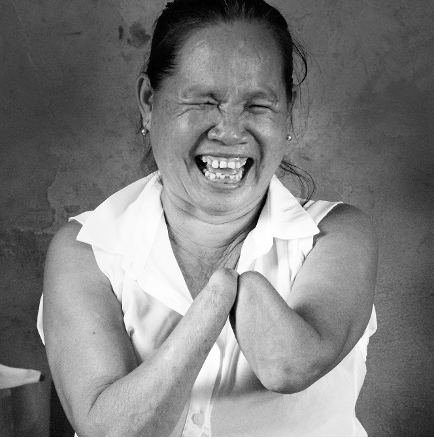
Let’s read this photo.
This isn't strictly street photography, but since I took it while out on a shoot, I categorize it as such.
This woman is the mother of a beautiful young girl. Her face is that of an ordinary Lao woman, yet her smile is incredibly peaceful. It is a smile that has reached a state of grace where the fact that she has no hands no longer seems to matter. How tragic must it be to live without hands? Yet, her smile gathers those missing hands into a Sabaidee (greeting). We cannot help but wonder how she has lived her life. As a parent, can you imagine living without hands? How did she make it to this age?
When you take an interest, questions arise. A photograph is not something to just look at and pass by; it is something to be seen and felt. In an era where "feeling" has all but vanished, wishing for this might be like throwing an egg at a rock, but we must live with that kind of leisure of the mind—the room to think.
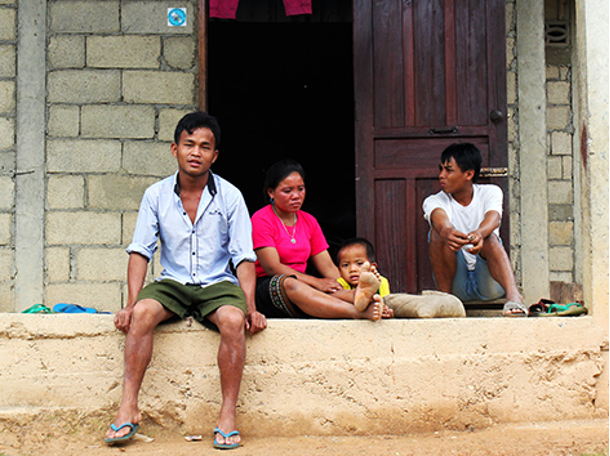
Look at this photo.
It is a family portrait. In rural Laos, you see many houses like this—bricks are stacked, but never finished. In a typical household, the woman works while the man eats and idles. In this house, however, the woman looks burdened with worry.
Looking at the colors, the magenta stands out against the drab, black background, quietly shouting, "I am the protagonist of this photo." The Rule of Thirds is applied well, and the face of the anxious woman—the center of this piece—sits almost perfectly in the middle. It defines the entire atmosphere.
Photography is about making the viewer feel the artist’s intent through a cold, mechanical tool called a camera. A masterpiece is a photo that makes you feel without needing the artist's explanation, but reaching that limit requires a guide full of knowledge. In other words, you need someone with "the gift of gab" by your side.
As with all things, there is no such thing as a "lone wolf" who succeeds entirely alone. We must go forward together.
0 Comments