


The acting profession is fundamentally the art of pretending—playing a role that is not your own. Master this, and fame and wealth follow. In the past, Koreans dismissively called them ttanddara, regarding them as mere clowns or jesters.
However, the current era has undergone a 180-degree paradigm shift.
Today, it is not just actors; ordinary people must also perform well to thrive. Reality shows dominate the cultural landscape, and taking it a step further, podcasts now eclipse traditional media in popularity. To those distanced from authentic reality, these curated performances somehow feel more genuine.
But do we really believe they aren't following a script like traditional actors? Everyone has an agenda. And naturally, they gather to spin their narratives where those agendas align. "This is my ideology!"—they declare, transforming themselves into famous brands, mingling only with those who reside in the same grand mansions. The very moment their metaphorical masks thicken, they become actors. The only question that remains is how convincing an actor they can be. Once someone becomes a prominent brand, they must relentlessly demonstrate why they hold those beliefs every single day. That becomes their life's work. In this rapidly shifting era, failing to do so means fading popularity and a dry bank account. There has never been a better time in history for actors to achieve fame and inflate their wealth.
In Western culture, actors were respected from the beginning, elevated under the revered title of 'Artist.' The modern concept of the 'actor' was essentially forged in the West. In the East, as it absorbed Western cultural norms, the derogatory term ttanddara faded into obscurity. Suddenly, acting became the most coveted profession. South Korea, in particular, has shifted into fifth gear and is currently cruising at top speed in this cultural phenomenon.
K-Pop now moves teenagers around the globe to tears. Brilliant, deeply talented individuals are unleashing their unique national spirit. The dramatic transformation of a once-devastated, divided nation over mere decades is, in itself, the ultimate performance by a master actor. How can one not give a standing ovation? Except, perhaps, for the politicians who are still engaged in Joseon-era factional brawls...
He who wishes to take a photograph must become an Observer. Watch. See first, wait patiently, and never miss the fleeting moment. That 'moment' reveals itself only to those who are prepared. And that preparation is the mastery of photographic craft.
This is the story of one such photograph.
Returning home from a government assignment, a photographer was driving down a rural road when he spotted a magnificent moon rising in the sky, hovering over a cemetery. He immediately slammed on the brakes. The fading light was just barely grazing the tops of the tombstones. It was sunset, and the light was critically low. He swiftly mounted his 8x10 view camera onto a tripod and loaded the sheet film. A view camera requires a light meter to calculate exposure, but in his desperate race against time, he realized he was without one. However, his mind held the mathematical secret to reading the light. Knowing the exact luminance of the moon, he calculated the exposure accordingly. He rapidly exposed a single frame. He attempted to capture a second shot, but mercilessly, the sun withdrew its vital light and vanished below the horizon. It was a miraculous convergence of events where a single exposure birthed a photograph of destiny.
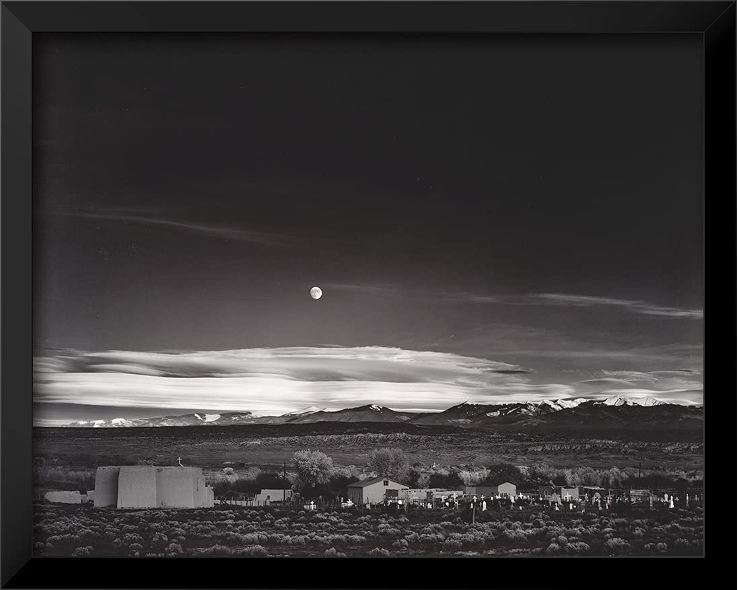
Ansel Adam
To anyone versed in photography, this is the widely celebrated tale of Ansel Adams’s Moonrise, Hernandez, New Mexico. It is a story intrinsically tied to the analog era—a narrative that simply could not emerge in today's age of absolute automation.
For forty years, Adams continuously experimented, finding countless ways to print that single negative.
Back then, a print of Moonrise sold for a mere $500. Today, you would have to part with nearly a million dollars at auction to acquire one. Had Adams lacked his profound mastery of the craft, the photograph known as Moonrise would simply not exist. Executing such a definitive decision in a matter of seconds demands an unshakable, rock-solid foundation.
In the era we inhabit, a photographer must stand as an observer grounded in formidable fundamentals, authoring the unfolding stories of our world. The profound weight of this role is a noble one—the very kind of nobility that transforms a $500 piece of paper into a million-dollar legacy.
To be born into an era and leave behind a definitive, enduring story is not a mere "charade" that anyone can perform. Rather than living a lavish life as an actor, rather than mastering the skill of imitating someone you are not, isn't the value of a storyteller—one who pursues an incomparable, unyielding truth—infinitely greater?
This is precisely why Picasso remains so vividly etched into my consciousness. Though a painter rather than a photographer, he was the absolute embodiment of a true artist. When he fully grasped the power and existence of the photographic medium, he felt that the necessity to meticulously paint reality had vanished. Yet, he remained a living legend. Throughout his life, he brought his art to its absolute zenith, freely reveling in the privileges that his sheer artistic worth afforded him.
Wouldn't you, too, aspire to ascend to such revered heights?
0 Comments